
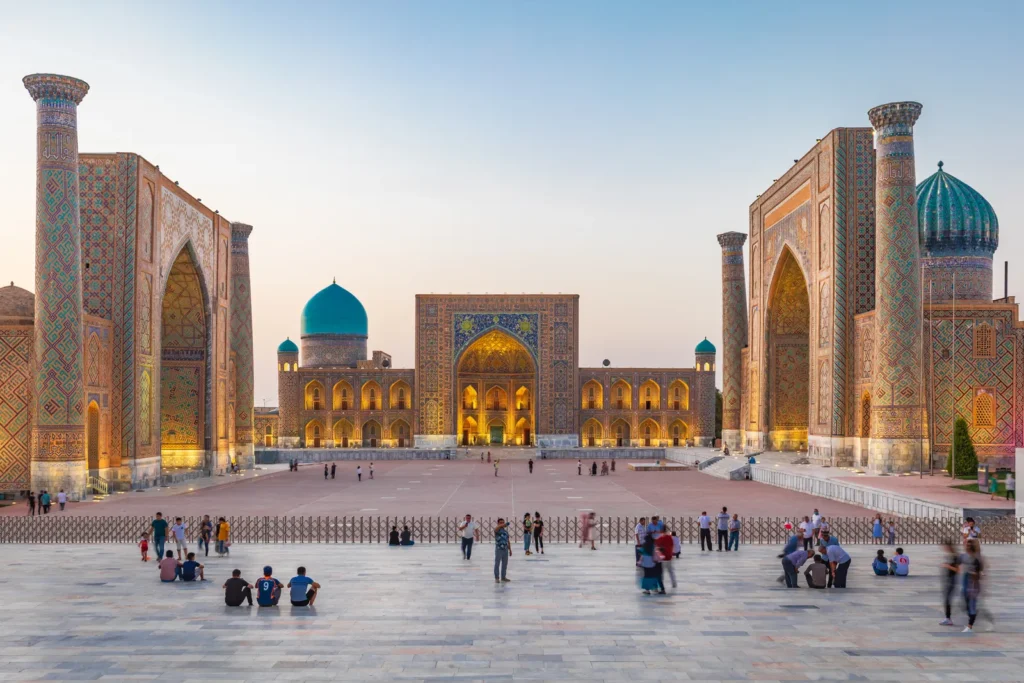
Imagine walking through a city where ancient caravans once rested beneath turquoise domes that pierce the sky like jeweled crowns. Welcome to Samarkand—the crown jewel of the Silk Road and one of Central Asia’s most enchanting destinations. When you discover the Silk Road beauty of Samarkand, you’re not just visiting a historic city; you’re stepping into a living museum of Persian, Islamic, and Turkic artistry. From its legendary Registan Square to the hauntingly beautiful Shah-i-Zinda necropolis, every corner whispers tales of empires, traders, and poets who shaped world history along this fabled trade route.
Why Samarkand Is the Heart of Silk Road Heritage
Samarkand isn’t just a stop on the Silk Road—it’s the very soul of it. For over two millennia, this Uzbek city served as a critical crossroads where East met West, where spices, silk, paper, and ideas flowed freely across continents. Its strategic location made it a magnet for merchants, scholars, and conquerors alike, including Alexander the Great and Timur (Tamerlane), whose vision transformed Samarkand into a global capital of culture and power. Today, that legacy lives on in its UNESCO-listed architecture, vibrant bazaars, and enduring spirit of exchange.
What sets Samarkand apart from other Silk Road cities is its extraordinary preservation and architectural harmony. Unlike many ancient sites that exist only in ruins, Samarkand feels alive—its monuments still dominate the skyline, its mosques still call the faithful to prayer, and its streets still echo with the footsteps of curious travelers. To discover the Silk Road beauty of Samarkand is to witness history not as a relic, but as a continuous narrative woven into the fabric of daily life.
Architectural Marvels That Define Samarkand’s Skyline
The visual identity of Samarkand is defined by its breathtaking Islamic architecture—domes clad in azure mosaics, towering minarets, and intricate geometric tilework that seems to shimmer under the Central Asian sun. At the heart of it all stands the Registan, a trio of madrasahs (Islamic schools) built between the 15th and 17th centuries. The Ulugh Beg Madrasah, Sher-Dor Madrasah, and Tilla-Kari Madrasah form a symmetrical ensemble that showcases the zenith of Timurid design, blending astronomy, theology, and art into one cohesive vision.
Beyond the Registan, the Shah-i-Zinda complex offers another layer of architectural splendor. This necropolis, meaning “Tomb of the Living King,” is believed to house the grave of Qusam ibn Abbas, a cousin of the Prophet Muhammad. Its rows of mausoleums rise like a staircase to heaven, each adorned with glazed tiles in cobalt, emerald, and gold. Walking through its narrow lanes feels like moving through a celestial garden, where every archway frames a new masterpiece of ceramic artistry.
Gur-e-Amir: The Mausoleum That Inspired the Taj Mahal
No exploration of Samarkand’s architecture is complete without visiting Gur-e-Amir, the final resting place of Timur. This mausoleum, with its iconic fluted azure dome and imposing iwan (vaulted hall), set the architectural template for later masterpieces—including India’s Taj Mahal. Built in the early 15th century, Gur-e-Amir combines Persian symmetry with Central Asian grandeur, its interior lined with jade, marble, and inscriptions from the Quran. The tomb’s simplicity belies its profound influence on Islamic funerary architecture across Asia.
What makes Gur-e-Amir especially poignant is its historical weight. Timur, though a brutal conqueror, was also a patron of the arts who envisioned Samarkand as the cultural center of the world. His mausoleum reflects that ambition—every detail, from the calligraphy to the acoustics, was meticulously crafted to inspire awe. Standing beneath its dome, you can almost hear the echoes of court poets and astronomers who once gathered here under Timur’s patronage.
Samarkand’s Cultural Tapestry: A Blend of Traditions
Samarkand’s beauty isn’t only skin-deep—it’s rooted in a rich cultural mosaic shaped by centuries of interaction. As a Silk Road hub, the city absorbed influences from China, India, Persia, Arabia, and even Europe. This fusion is evident in its cuisine, music, crafts, and religious practices. Local dishes like plov (pilaf) and shashlik (grilled meat skewers) reflect Central Asian flavors with subtle Persian and Turkic twists, while traditional instruments like the dutar and tanbur echo melodies carried across deserts and mountains.
Religious tolerance has long been a hallmark of Samarkand’s identity. While Islam dominates, the city is also home to Christian, Jewish, and Zoroastrian communities, each contributing to its spiritual diversity. The historic Orthodox Church of St. Nicholas and the ancient Jewish quarter near the Siab Bazaar remind visitors that Samarkand was never a monocultural enclave. This pluralism continues today, with interfaith dialogue and cultural festivals fostering a sense of shared heritage.
The Role of Astronomy and Science in Samarkand’s Golden Age
Under the rule of Ulugh Beg, Timur’s grandson, Samarkand became a beacon of scientific advancement. In the 15th century, Ulugh Beg established an observatory that rivaled any in the world, employing astronomers to map the stars with unprecedented accuracy. His star catalog, compiled in 1437, remained the most precise for over a century and influenced European astronomers during the Renaissance.
The Ulugh Beg Observatory, though now in ruins, stands as a testament to Samarkand’s intellectual legacy. Its massive sextant, carved into a hillside, allowed precise measurements of celestial movements. Today, a reconstructed model and museum help visitors grasp the scale of this achievement. For those interested in the intersection of science and culture, this site offers a unique window into how the Silk Road wasn’t just about trade—it was also a conduit for knowledge.
Experiencing Samarkand Beyond the Monuments
While Samarkand’s monuments are undeniably spectacular, the true magic lies in experiencing the city as a living community. Start your day at the Siab Bazaar, where locals gather at dawn to buy fresh bread, dried fruits, spices, and handwoven textiles. The air fills with the scent of cumin, saffron, and freshly baked non (flatbread), while vendors call out in Uzbek, Russian, and Tajik. This market isn’t just a place to shop—it’s a sensory immersion into daily life.
For a deeper connection, consider staying in a traditional guesthouse (mehmonxona) run by a local family. These homes often feature courtyard gardens, hand-painted ceilings, and home-cooked meals that reflect regional recipes passed down through generations. Hosts are typically eager to share stories, teach a few Uzbek phrases, or invite you to a tea ceremony—simple moments that reveal the warmth and hospitality at the heart of Samarkand’s culture.
Festivals and Events That Bring Samarkand to Life
Throughout the year, Samarkand hosts cultural events that celebrate its Silk Road legacy. The annual Sharq Taronalari (Melodies of the East) music festival attracts performers from across Central Asia, showcasing traditional instruments, dance, and vocal styles. Held in the Registan Square, the festival transforms the historic site into a stage for contemporary interpretations of ancient art forms.
Another highlight is Navruz, the Persian New Year celebrated in March. Streets come alive with music, folk dances, and communal feasts. Locals prepare somsa (meat pies), halva, and colored eggs, symbolizing renewal and unity. Participating in Navruz offers a rare glimpse into how ancient traditions remain vibrant in modern Samarkand.
Practical Tips for Travelers Seeking the Silk Road Beauty of Samarkand
To fully discover the Silk Road beauty of Samarkand, thoughtful planning enhances the experience. The best time to visit is during spring (April–May) or autumn (September–October), when temperatures are mild and the skies are clear. Summers can be scorching, while winters bring occasional snow, which, while picturesque, may limit access to some outdoor sites.
Most travelers arrive via Samarkand International Airport, with direct flights from Istanbul, Moscow, and Dubai. Alternatively, the high-speed Afrosiyob train connects Tashkent to Samarkand in just over two hours, offering scenic views of the Zarafshan Valley. Once in the city, walking is the best way to explore the historic center, though taxis and ride-sharing apps like Yandex.Go are affordable and convenient.
Must-Visit Sites for First-Time Visitors
- Registan Square – The iconic heart of Samarkand, best visited at sunrise or sunset for golden-hour photography.
- Shah-i-Zinda – A spiritual and artistic journey through a necropolis of stunning mausoleums.
- Gur-e-Amir – Timur’s mausoleum, a masterpiece of Timurid architecture.
- Bibi-Khanym Mosque – Once the largest mosque in the Islamic world, now partially restored.
- Ulugh Beg Observatory – A tribute to Samarkand’s scientific heritage.
- Siab Bazaar – A vibrant market offering local food, crafts, and daily life immersion.
Preserving Samarkand’s Legacy for Future Generations
As tourism grows, so does the responsibility to protect Samarkand’s fragile heritage. UNESCO has played a key role in safeguarding its monuments, but challenges remain—urban development, climate change, and overtourism all pose risks. Local authorities have implemented conservation programs, including tile restoration, structural reinforcement, and visitor management systems to balance access with preservation.
Travelers can contribute by practicing responsible tourism: respecting dress codes at religious sites, avoiding flash photography, supporting local artisans, and staying in eco-friendly accommodations. Many guesthouses now use solar power, recycle water, and source food locally—small steps that make a big difference in sustaining Samarkand’s authenticity.
The Future of Samarkand in the Modern Silk Road
Today, Samarkand is re-emerging as a symbol of connectivity. China’s Belt and Road Initiative has revived interest in the ancient Silk Road, with new rail links and cultural exchanges strengthening ties across Eurasia. While commercial interests grow, there’s hope that Samarkand will remain a beacon of cultural dialogue rather than just a trade node.
Educational programs, museum expansions, and digital archives are helping younger generations engage with their heritage. Virtual tours and augmented reality apps now allow global audiences to explore Samarkand remotely, ensuring its stories reach far beyond its borders.
Key Takeaways
- Samarkand is the cultural and architectural heart of the Silk Road, offering a unique blend of history, art, and living tradition.
- Its monuments—like the Registan, Shah-i-Zinda, and Gur-e-Amir—are masterpieces of Islamic architecture with global influence.
- The city’s cultural richness stems from centuries of trade, migration, and intellectual exchange.
- Visitors can experience authentic local life through markets, guesthouses, and festivals.
- Responsible travel and preservation efforts are essential to protect Samarkand’s legacy for future generations.
Conclusion
To discover the Silk Road beauty of Samarkand is to embark on a journey through time, where every tile, dome, and alleyway tells a story of human connection. This is not a city frozen in the past—it’s a dynamic, breathing testament to the enduring power of culture, faith, and curiosity. Whether you’re marveling at the symmetry of the Registan, sipping green tea in a sun-drenched courtyard, or tracing the stars mapped by Ulugh Beg, Samarkand leaves an indelible mark on the soul. It reminds us that the Silk Road was never just about goods—it was about ideas, beauty, and the timeless desire to explore.
FAQs
What makes Samarkand unique among Silk Road cities?
Samarkand stands out due to its exceptional preservation of Timurid-era architecture, its role as a cultural and scientific hub, and its continuous habitation over millennia. Unlike many Silk Road sites that are now ruins, Samarkand remains a vibrant city where history and modern life coexist.
Is Samarkand safe for tourists?
Yes, Samarkand is considered very safe for travelers. Uzbekistan has invested heavily in tourism infrastructure, and locals are known for their hospitality. Standard precautions—like avoiding isolated areas at night—apply, but overall, visitors report feeling welcome and secure.
How many days should I spend in Samarkand?
Most travelers spend 2–3 days to fully experience Samarkand’s major sites, markets, and cultural experiences. This allows time for guided tours, photography, and interactions with locals without feeling rushed.
